
Upcoming Events
Past Events

A fundamental challenge to understanding the brain is its complexity: its genetic and developmental programs, its neurons and connections, its balance of permanence and plasticity, and the nuanced information flow through its networks. Across biology, emerging technologies are revolutionising the scope and scale at which we can address such questions. Our group has developed technologies for studying brain-wide sensory networks using calcium imaging and house-built light-sheet microscopes. Because zebrafish larvae are small and transparent, we can image tens of thousands of neurons, simultaneously and individually, as animals perceive and respond to sensory stimuli. We have used this approach to produce the first functional maps, brain-wide at cellular resolution, for auditory, vestibular, and water flow perception in a vertebrate. Our lab and others have also used such baseline descriptions as a departure point for exploring altered sensory networks in zebrafish models of neuropsychiatric conditions such as autism.
These imaging studies have taught us where and when neurons are active, but not how or why. In this talk, I will review our calcium imaging approaches and results, and will then discuss how other technologies, such as X-ray diffraction, electron microscopy, and spatial transcriptomics can provide complementary information about the structure and function of brain-wide networks. I will present preliminary data using these platforms and discuss the enormous potential that such combined approaches hold, but also the technical challenges that merging these big-data modalities presents.

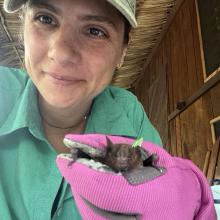
Abstract: Bats are highly social animals with complex vocal communication systems supporting navigation and social interactions. My research investigates the neural and behavioral mechanisms underlying social cohesion, auditory perception, and communication in bats. From a neuropathological perspective, integrating behavioral ecology with neural systems approaches, my lab explores fundamental questions such as how bats recognize roost mates and how this may influence roost fidelity, how hierarchical social structures form, and how context shapes responses to communication sounds. To explore these questions we employ a multidisciplinary approach, combining behavioral assays, electrophysiological recordings, neuroanatomical mapping, and computational modeling; spanning both controlled laboratory settings and field environments. In this talk, I will provide an overview of our recent advances and strategies to answer these questions and discuss how our work provides key insights into the neural mechanisms and behavioral ecology of auditory communication in mammals.

In this talk, I will examine the computational motivations and empirical evidence for spatiotemporal dopamine (DA) waves that support reward learning within fronto-striatal networks. I will focus on the cognitive striatum as a case study to show that DA waves tailor decision signals according to local computational/behavioral specialty-- accomplished via vector-weighting delays in DA pulses across space and time. This code resolves key computational challenges in competing C-BG mixture of experts: spatiotemporal credit assessment at reward, and dynamic reprioritization of circuit inference and gating during performance. Ultimately, these DA wave dynamics represent an empirically informed revision of the longstanding "global broadcast" hypothesis of DA RPE signals. Finally, I will briefly summarize our recent attempts at understanding the complexity of the DA wave manifold, and competitive/collaborative circuit interactions that constrain DA to motif trajectories during specific task demands.

Abstract: Dexterous movement is a hallmark of human motor ability, enabling us to interact skillfully with our environment. The loss of this capability due to movement disorders, such as Parkinson’s disease or stroke, strips individuals of independence and quality of life. This talk explores the neural underpinnings of dexterity, focusing on how the nervous system integrates sensory and motor signals to achieve precise control. We then examine how these mechanisms break down in movement disorders, leading to impaired motor function. Finally, we turn to neuroengineering technologies which aim to restore movement in affected individuals. By leveraging advances in neural interfaces and wearable systems, we are seeking to design systems to repair motor function. Overall, we highlight our highly interdependent scientific and translational goals to understand and restore complex movement.



Studying the neural basis of prey catching behavior across species for over 60 years has significantly advanced our understanding of the most conserved aspects of visual system function. Our team builds upon this important foundation to understand how fundamental visual processes, such as motion-triggered visual orienting, evolve across species and are modulated within species by life-stage and/or reproductive status. Towards this goal, we primarily study the neural basis of motion- and prey-triggered natural visual orienting behavior in the mouse model. Our specific aims are to understand the neural circuit subcortical mechanisms that critically regulate adaptive variations in these behaviors that depend on developmental stage, sex and hunger drive. Predatory behaviors and related visual orienting, are strategically regulated across species by these internal “states” in particular across a broad range of species from birds and bats to primates.