Upcoming Events






Past Events


Abstract: Sensory systems continuously adapt their responses based on the statistics of the environment. The response changes induced by adaptation have been characterized in detail at the single-neuron level and in trial-averaged populations. However, it remains unclear how adaptation modifies aspects of representations that relate more directly to stimulus perception. To address this question, we recorded from a population of neurons in mouse V1 while presenting stimulus sequences sampled from different statistical distributions. Surprisingly, discriminability increased between more frequent stimuli, even as responses to those stimuli decreased—an effect we reproduced in artificial networks trained to reconstruct stimuli under metabolic constraints. Furthermore, we found that the average population response follows a power law of stimulus probability with an exponent invariant across environments. Our efficient coding framework reproduced this power law and explained its invariance. These results suggest that the observed adaptation-induced changes in neural representations reflect a common trade-off between representational fidelity and metabolic cost, consistent with efficient coding.

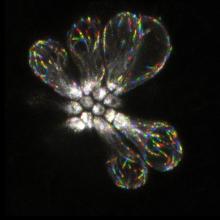
Abstract: Sensory hair cells transmit auditory and vestibular information to the brain. While many forms of hearing loss result from hair cell death, increasing evidence shows that noise-induced and age-related hearing loss often stem from synaptic damage. Restoring hearing in these cases will require rebuilding synaptic connections, which depends on understanding how sensory synapses form and function in vivo. Our work combines genetics, CRISPR-based mutagenesis, and live imaging in zebrafish neuromast hair cells to define the molecular and activity-dependent mechanisms that drive synapse formation, function, and regeneration. By visualizing synapses in a live, transparent system, we aim to uncover principles that guide the restoration of hair cells and their synaptic connections after damage.

The goal of research in the Sawtell laboratory is to forge detailed links between the properties of neural circuits and their functions. Our studies of weakly electric fish have shown how a specific form of synaptic plasticity operating within a well-characterized cerebellum-like circuit functions to predict and cancel out sensory inputs generated by the animal’s own behavior. Such a process could allow behaviorally relevant sensory inputs, e.g. those generated by predators or prey, to be processed more effectively. This work provides a mechanistic account of how copies of motor commands are transformed into specific predictions of sensory events as well as insights into the function of the cerebellar granular layer. A tight coordination of experimental and theoretical approaches is a key aspect of the lab’s approach. Experimental work involves intra- and extracellular recordings from identified neuron classes in awake, behaving fish. Theoretical work is performed in collaboration with Larry Abbott’s group at the Center for Theoretical Neuroscience at Columbia University.

Abstract:
To maintain a functional mitochondrial population in a long-lived cell like a neuron, mitochondria must be continuously replenished through the process of mitochondrial biogenesis. Because the majority of mitochondrial proteins are nuclear encoded, mitochondrial biogenesis requires communication between mitochondria and the nucleus. This can be a challenge in a large, compartmentalized cell like a neuron in which a large portion of the mitochondrial population is in neuronal compartments far from the nucleus. Using in vivo assessments of mitochondrial biogenesis in zebrafish neurons, we determined that mitochondrial transport between distal axonal compartments and the cell body is required for sustained mitochondrial biogenesis. Estrogen-related receptor transcriptional activation links transport with nuclear expression of mitochondrial genes. New data suggests this regulation supports cell body based and local mitochondrial biogenesis at the synapse which we hypothesize work together to support distal mitochondrial populations. Together, our data support a role for retrograde feedback between axonal mitochondria and the nucleus for regulation of mitochondrial biogenesis in neurons.
Image