Upcoming Events
Past Events

Abstract
How does music processing relate to social cognition? This presentation discusses recent research in the social and affective neuroscience of music listening, specifically how music relates to empathy. Reporting results from recent experiments examining the effects of individual differences in trait empathy and empathic accuracy on music processing (using neuroimaging and behavioral techniques), I argue that empathic processes are as essential to musical behaviors as they are to our navigation of the social world. Recent evidence suggests that certain aspects of music may have piggybacked on neural architecture that originally evolved for social interaction. I close with a brief discussion of some exciting future developments at the interface of music cognition and empathy research.
Bio
Zachary Wallmark is Associate Professor and Area Chair of Musicology at the University of Oregon, where he also holds an affiliate faculty appointment with the Center for Translational Neuroscience. Working at the intersection of the cognitive sciences and musicology, Wallmark’s research seeks to account for social cognitive dimensions of musical practices, focusing on the role of timbre in affective response, aesthetic judgment, and music sociology, particularly in the context of post-1945 American popular music. He is author of Nothing but Noise: Timbre and Musical Meaning at the Edge (Oxford, 2022) and co-editor of the AMS Solie Award-winning volume, The Relentless Pursuit of Tone: Timbre in Popular Music (Oxford, 2018), among numerous articles in both humanistic and scientific journals. His work has been supported by the NEH and the Grammy Museum Foundation.

Abstract: Learned associations between stimuli in different sensory modalities can shape the way we perceive these stimuli (Mcgurk and Macdonald, 1976). During audio-visual associative learning, auditory cortex has been shown to underlie multi-modal plasticity in visual cortex (McIntosh et al., 1998; Zangenehpour and Zatorre, 2010). However, how processing in visual cortex is altered when an auditory stimulus signals a visual event and what the neural mechanisms are that mediate such experience-dependent audio-visual associations is not well understood. Here we describe a neural mechanism that contributes to shaping visual representations of behaviorally relevant stimuli through direct interactions between auditory and visual cortices. We show that auditory association with a visual stimulus leads to an experience-dependent suppression of visual responses in visual cortex. This suppression of the predictable visual stimulus response is driven in part by input from auditory cortex. By recording from auditory cortex axons in visual cortex, we find that these axons carry a mixture of auditory and retinotopically matched visual input. Moreover, optogenetic stimulation of auditory cortex axons in visual cortex selectively suppresses the neurons responsive to the associated visual stimulus after, but not before, learning. Our results are consistent with the interpretation that cross-modal associations can be stored in long-range cortical connections and that with learning these cross-modal connections function to suppress the responses to predictable input.

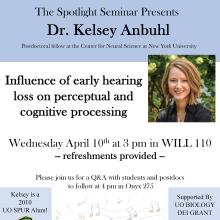
Please join us on Wednesday April 10th for a special seminar with Dr. Kelsey Anbuhl a postdoc at the Center for Neural Science at New York University. Kelsey is the selected Spotlight Seminar speaker based on community nominations and the event is supported by a UO Biology DEI grant. She will give a 50 min. research seminar at 3 pm in Willamette 110 on her work investigating the cognitive and perceptual consequences of adolescent hearing loss.
The talk will be targeted at a broad science audience!
At 4 pm in Onyx 275 we will also host a Q&A for trainees with Kelsey and she will talk about her career trajectory and how her own experience with hearing loss inspired her research. See flyer for additional details and we hope to see you there!
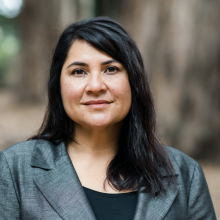
Please note the location change to the Knight Campus Beetham Family Seminar Room and earlier pre-seminar reception start time of 3:30 p.m. for this week's seminar.
From the sky bridge, cross to Knight Campus and take either the stairs of elevator to the first floor (street level). The seminar room will be to the left, and the reception will be just outside of the room.
My lab aims to understand the molecular mechanisms underlying the sensations of itch, touch, and pain. Humans rely on these senses for a broad range of essential behaviors. For example, acute pain acts as a warning signal that alerts us to noxious mechanical, chemical, and thermal stimuli, which can potentially damage tissue. Likewise, itch sensations trigger reflexes that may protect us from disease-carrying insects. Despite these essential protective functions, itch and pain can outlast their usefulness and become chronic diseases. We use cellular physiology, molecular biology, molecular genetics, and behavioral studies to elucidate the mechanisms underlying itch and pain transduction under normal and pathophysiological conditions. This talk will highlight the interactions between the nervous system and immune system that promote chronic itch, pain, and inflammation.