
Abstract: For an animal to perform any function, millions of cells in its body furiously interact with each other. Be it a simple computation or a complex behavior, all biological functions involve the concerted activity of many individual units. A theory of function must specify how to bridge different levels of description at different scales. For example, to predict the weather, it is theoretically irrelevant to follow the velocities of every molecule of air. Instead, we use coarser quantities of aggregated motion of many molecules, e.g., pressure fields. Statistical physics provides us with a theoretical framework to specify principled methods to systematically ‘move’ between descriptions of microscale quantities (air molecules) to macroscale ones (pressure fields). Can we hypothesize equivalent frameworks in living systems? How can we use descriptions at the level of cells and their connections to make precise predictions of complex phenomena? My research focuses on the theory, modeling, and analysis required to discover generalizable forms of scale bridging across species and behavioral functions. In this talk, I will present lines of previous and ongoing research that highlight the potential of this vision. I shall focus on two seemingly very different systems: mouse brain neural activity patterns, and octopus skin cells activity patterns. In the mouse, we reveal striking scaling behavior and hallmarks of a renormalization group- like fixed point governing the system. In the octopus, camouflage skin pattern activity is reliably confined to a (quasi-) defined dynamical space. Finally, I will touch upon the benefits of comparing across animals to extract principles of multiscale function in biological systems, and discuss potential avenues of investigation that could allow us to decipher how macroscale properties, such as memory or camouflage, emerge from microscale level activity of individual cells.
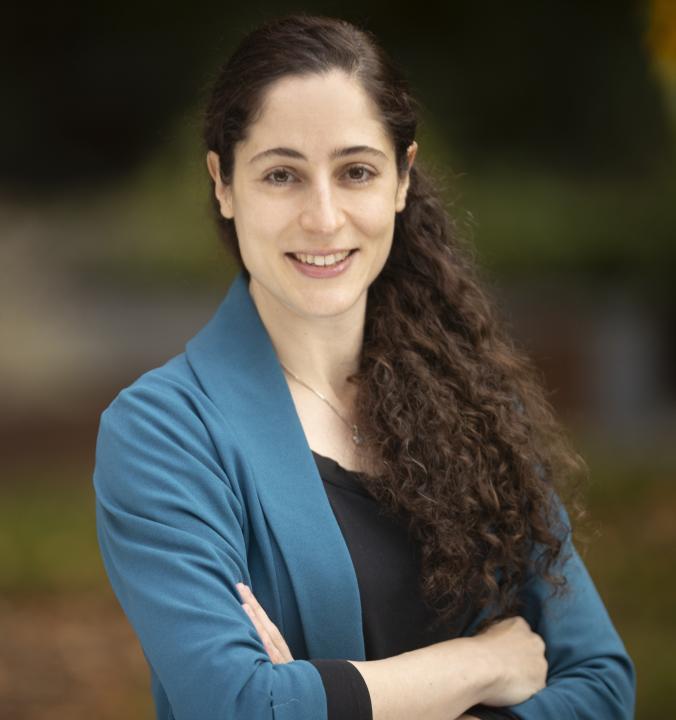
Leenoy Meshulam is a theory fellow at the University of Washington in Seattle, and a Burroughs Wellcome CASI awardee. Her research interests are at the intersection of physics, biology, and neuroscience. Dr. Meshulam received her Ph.D. from Princeton University in 2018. Prior to that, she completed her M.Sc. summa cum laude at Tel Aviv University in 2012 and graduated the Adi Lautman Interdisciplinary Honors Program for Outstanding Students.