

Rescheduled from Spring 2023
Abstract: It has long been appreciated (and celebrated) that certain species have sensory capabilities that humans do not share, for example polarization, ultraviolet, and infrared vision. What is less appreciated, however, is that our position as terrestrial human scientists can significantly affect our study of animal senses and signals, even within modalities that we do share. For example, our acute vision can lead us to over-interpret the relevance of fine patterns in animals with coarser vision, and our Cartesian heritage as scientists can lead us to divide sensory modalities into orthogonal parameters (e.g. hue and brightness for color vision), even though this division may not exist within the animal itself. This talk examines three cases from marine visual ecology where a reconsideration of our biases as sharp-eyed Cartesian land mammals can help address questions in visual ecology. The first case examines the enormous variation in visual acuity among animals with image-forming eyes and focuses on how acknowledging the typically poorer resolving power of animals can help us interpret the function of color patterns in cleaner shrimp and their client fish. The second case examines eye size and visual range in deep-sea cephalopods and shows that increasing pupil diameter is often far less advantageous in water than in air. The final case examines the how the typical division of polarized light stimuli into angle and degree of polarization is problematic, and how a Stokes vector interpretation is both closer to the physiological truth and resolves several issues, particularly when considering the propagation of polarized light through water.
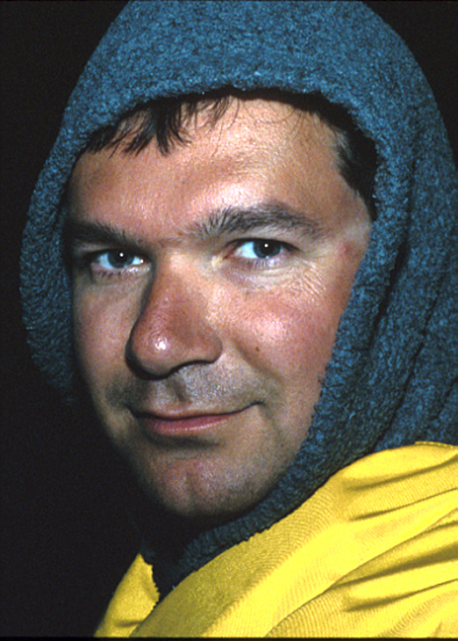
Bio: Originally trained in mathematics and art, Sönke Johnsen has studied optics in biology for the last 32 years, the last 21 of which have been at Duke University. He is particularly interested in vision, signaling, and camouflage in the open ocean, but has also worked on coastal, freshwater, and terrestrial species, animal navigation, nocturnal vision, and human cataracts. His research combines mathematical analyses with behavioral and morphological studies and in situ measurements and imagery. His field work primarily involves open-ocean research cruises that use SCUBA, and deep-sea manned and robotic submersibles, and other imaging and collecting platforms. In addition to exploring the evolution and diversity of the optical and visual tricks that animals perform, Professor Johnsen is interested in improving communication between theoretical and experimental scientists, biologists and physicists, and scientists and artists. Outreach is a strong focus, and Johnsen’s research has been featured in many traditional media outlets, but also in Finding Nemo, The Magic Treehouse book series, the poetry of John Updike, the humor of Dave Barry, and most recently in Ed Yong’s An Immense World. Professor Johnsen has also written two books, The Optics of Life and Visual Ecology, and is currently completing a third on ocean life for a public audience. In his spare time, he is an avid nature photographer and amateur farmer.